

Fully Funded vs. Underfunded Reserves: What These Terms Mean for Community Associations
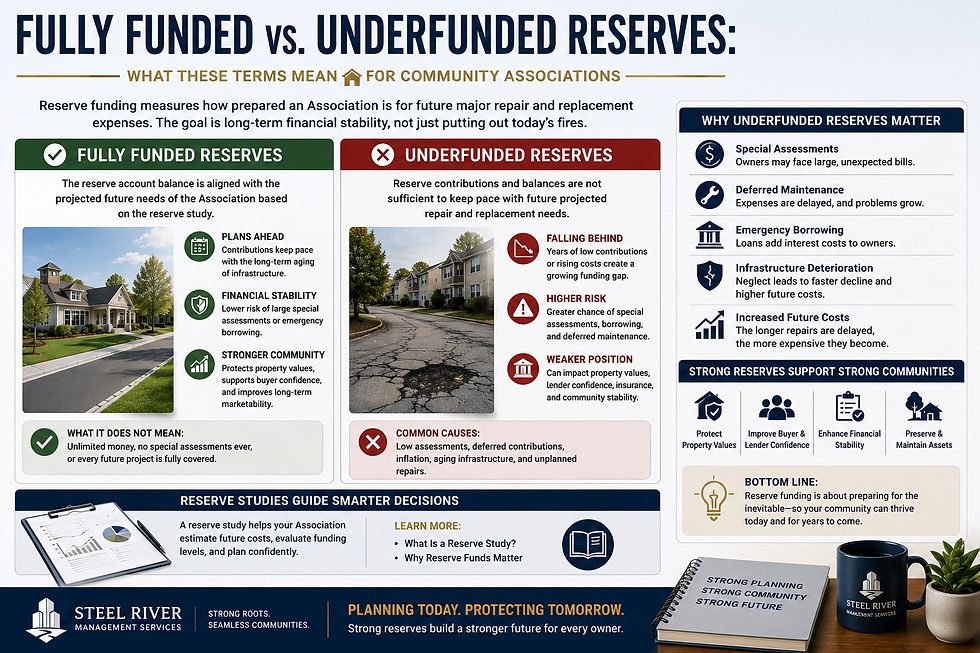
As reserve studies and long-term financial planning become increasingly important within community associations, homeowners and Boards are hearing terms like “fully funded” and “underfunded reserves” more frequently.
While these phrases may sound technical, they play a major role in understanding the long-term financial health and stability of an HOA or condominium association.
At a basic level, reserve funding measures how prepared an Association may be for future major repair and replacement expenses.
Community associations are responsible for maintaining shared infrastructure and common elements throughout the neighborhood. Depending on the community, this may include:
Roofs
Roads
Pools
Clubhouses
Elevators
Stormwater systems
Siding
Mechanical systems
Lighting
Retaining walls
Other major components
Over time, these components wear out and eventually require significant repairs or replacement.
Reserve funds are intended to help communities financially prepare for those future expenses gradually over time rather than relying entirely on sudden special assessments or emergency borrowing.
When an Association is considered “fully funded,” it generally means the reserve account balance is reasonably aligned with the projected deterioration and future replacement obligations of the Association’s components based on the reserve study.
In simple terms, the community is keeping pace with the long-term aging of its infrastructure.
A fully funded reserve position does not necessarily mean:
The Association has unlimited money
Special assessments can never occur
Every future project is guaranteed to be fully covered
Rather, it often indicates the Association is proactively planning for future obligations and contributing reserves at levels designed to support long-term financial stability.
On the other hand, “underfunded reserves” generally means reserve contributions and balances may not currently be sufficient to keep pace with future projected repair and replacement needs.
Underfunded reserves can occur for many reasons, including:
Years of artificially low assessments
Deferred reserve contributions
Unexpected inflation
Rising construction costs
Aging infrastructure
Major unplanned repairs
Incomplete reserve planning
One of the biggest misconceptions homeowners have is believing lower assessments always mean a financially healthier community.
In reality, some communities maintain lower monthly assessments by underfunding reserves for years. While this may temporarily reduce monthly owner costs, it can create much larger financial challenges later when major projects become unavoidable.
Communities with significantly underfunded reserves may face:
Special assessments
Deferred maintenance
Emergency borrowing
Rapid infrastructure deterioration
Increased future assessment pressure
Reduced financial flexibility
In some situations, underfunded reserves may also impact:
Buyer confidence
Mortgage lending considerations
Insurance evaluations
Property values
Marketability of the community
Reserve studies help Associations evaluate reserve funding levels and long-term financial planning needs.
For a more detailed explanation of reserve studies and reserve planning, please see our related articles:
and
For Boards, reserve funding decisions are an important part of fiduciary responsibility and long-term financial planning.
Strong reserve funding can help communities:
Reduce financial surprises
Improve budgeting stability
Support infrastructure maintenance
Preserve property values
Reduce reliance on special assessments
Improve long-term community confidence
While fully funded reserves may sometimes require higher ongoing assessments, many communities view reserve strength as an investment in long-term financial stability and infrastructure preservation.
Community associations operate much like any long-term property ownership structure: roofs age, roads deteriorate, mechanical systems fail, and major repairs eventually become unavoidable.
Reserve funding is ultimately about preparing for those realities in a more stable, predictable, and financially responsible way over time.
© 2026 Steel River Management Services, LLC. All rights reserved.


