

HOA Collection Timelines: What Homeowners and Boards Should Understand
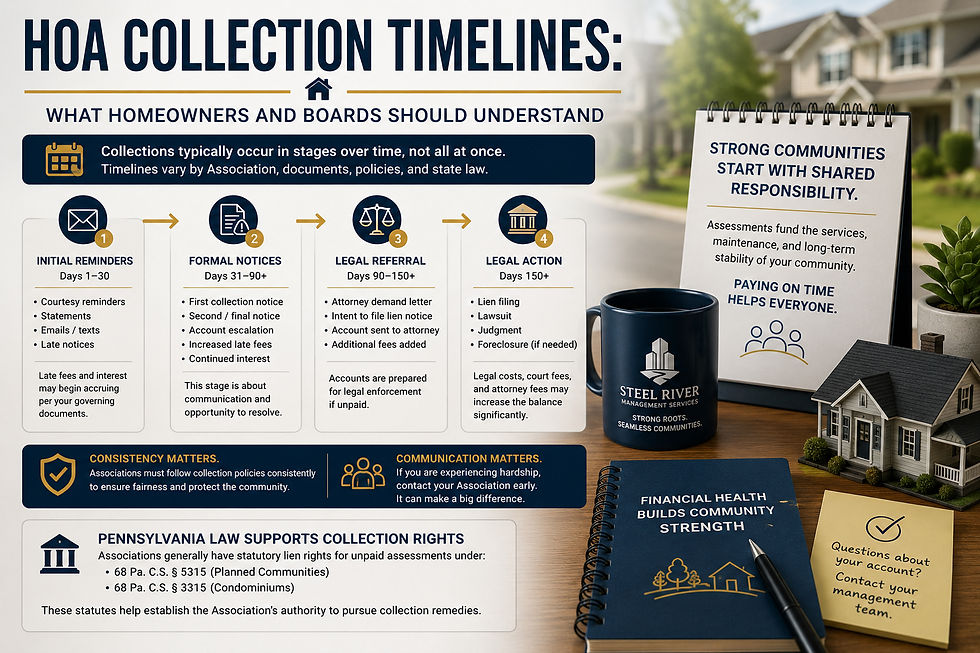
One of the most misunderstood areas within community associations is how collection timelines actually work once an account becomes delinquent.
Many homeowners assume collections begin immediately after a payment is missed. In reality, most Associations follow structured collection procedures established through:
Governing documents
Collection policies
Attorney recommendations
State statutes
Board resolutions
These timelines are designed to create consistency, provide notice to homeowners, and help Associations recover unpaid assessments while maintaining the financial stability of the community.
Although every Association is different, the collection process typically occurs in stages over time rather than all at once.
For many communities, the process may begin with:
Courtesy reminders
Statements
Late notices
Emails
Administrative notices
At this stage, the account may begin accruing:
Late fees
Interest
Administrative costs
depending on the governing documents and collection policy.
If the balance remains unpaid, the account may eventually move into formal collections.
This often includes:
First collection notices
Second or final notices
Attorney demand letters
Intent to lien notices
Legal referral
One of the biggest misconceptions homeowners have is believing that management companies or Boards can simply “turn off” collections on a case-by-case basis without consequences.
In reality, many Associations are required to follow established collection policies consistently in order to:
Avoid selective enforcement claims
Protect the financial health of the community
Maintain fairness across all owners
Preserve legal enforceability
This is one reason many communities adopt formal written collection policies approved by the Board.
Another important misunderstanding involves the difference between due dates and delinquency dates.
In many Associations:
Assessments may be due on the 1st
Accounts may not become late until the 15th or later
This means collections often do not begin immediately upon the original due date.
For a more detailed explanation of this topic, please see our related article:
Collection timelines can also vary significantly depending on:
The Association’s governing documents
Board-approved policies
Attorney involvement
Payment activity
State law requirements
Bankruptcy proceedings
Payment plans
Foreclosure status
Some communities may refer accounts to legal counsel after only a few months, while others may allow longer timelines before escalating collection activity.
Once legal collections begin, balances may increase more rapidly due to:
Attorney fees
Court costs
Filing fees
Certified mailing costs
Lien expenses
Additional collection charges
In Pennsylvania, Associations generally have statutory lien rights for unpaid assessments under:
68 Pa. C.S. § 5315 (planned communities)
68 Pa. C.S. § 3315 (condominiums)
These statutes help establish the Association’s authority to pursue collection remedies for unpaid assessments.
For homeowners experiencing financial hardship, communication is often one of the most important factors in preventing balances from escalating further. Many situations become significantly more difficult once accounts advance into attorney collections or legal proceedings.
Ignoring notices, however, may allow balances, fees, and legal exposure to continue growing over time.
For Boards, collection timelines are not simply about enforcement — they are about maintaining the financial stability of the community as a whole.
Associations still must continue funding:
Insurance
Maintenance
Reserve contributions
Vendor contracts
Utilities
Community operations
even when owners fail to pay assessments.
Ultimately, collection timelines are designed to create structure, consistency, and financial stability within the community while ensuring all owners contribute fairly toward the shared costs of operating and maintaining the Association.
© 2026 Steel River Management Services, LLC. All rights reserved.


